
Beyond Profiling: How Reconciliation Enhances Data Integrity and Confidence
In the changing landscape of enterprise data, senior risk managers and auditors face a rising challenge: how to ensure that information is not only accurate within systems but also consistent across them. As regulatory expectations grow and decision-making becomes more data-driven, the focus shifts from spotting isolated anomalies to providing systemic assurance.
Two methods often come into the conversation: data profiling and data reconciliation. Both serve important purposes, but when the priority is risk reduction and trustworthy reporting, reconciliation consistently proves to be the more powerful tool.
Profiling: Useful but Limited
Data profiling has long been a staple of data management. It examines the structure and content of a dataset, identifying anomalies such as missing values, duplicates, or statistical irregularities. This can be invaluable for improving the hygiene of an individual system.
However, profiling remains fundamentally inward-looking. It evaluates a dataset in isolation, without asking whether the information aligns with records in other critical systems. As a result, profiling helps detect quality concerns but offers limited assurance to risk managers or auditors who need to demonstrate that enterprise reporting is consistent, reliable, and defensible.
In short, profiling tells us what’s unusual within a dataset—but it does not confirm whether the numbers reported to regulators, investors, or executives are truly accurate. Profiling does not distinguish between noise and news, often leading to countless hours spent chasing a data ghost.
Reconciliation: The Assurance Layer
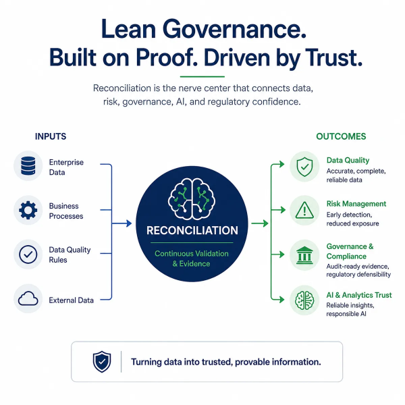
Data reconciliation takes a different approach. Rather than focusing solely on the internal quality of a dataset, reconciliation validates whether information remains complete, accurate, and consistent as it flows between systems, applications, and reporting layers.
This cross-system validation is where real risk lives. Financial misstatements, compliance violations, and even fraud rarely emerge from anomalies within a single dataset; they appear when systems disagree, processes break down, or reporting diverges from source data.
Reconciliation addresses precisely these vulnerabilities by ensuring:
Transactions recorded in one system match those in another.
Aggregated totals align between ledgers and subledgers.
Reported data faithfully reflects source-of-truth systems.
By doing so, reconciliation doesn’t just support “data quality” as an abstract concept. It delivers operational assurance that the organization’s most critical information is accurate and trustworthy.
Why Reconciliation Matters More for Risk Reduction
For leaders tasked with safeguarding enterprise integrity, reconciliation provides distinct advantages:
Cross-System Consistency – Risk emerges at the seams between systems. Reconciliation closes those seams.
Regulatory Confidence – Auditors and regulators expect verifiable alignment between reports and records. Reconciliation provides the evidence base.
Fraud and Error Prevention – Discrepancies across systems can signal deeper issues—something profiling alone would never catch.
Decision Assurance – Boards and executives need certainty. Reconciliation builds the trust that profiling cannot.
Moving Beyond Profiling-Only Approaches
As organizations mature their data risk practices, many are recognizing that profiling, while valuable, is not sufficient for the demands of today’s environment. The future of data assurance lies in reconciliation—embedding it into ongoing governance processes so that risks are caught and addressed before they materialize.
Forward-looking organizations are turning to platforms purpose-built to make reconciliation not just possible, but scalable, auditable, and efficient. Information Governance Data Quality (IGDQ) Solutions like InfoCheck® are enabling this shift by automating reconciliation, reducing manual effort, and ensuring transparency that satisfies both internal leadership and external regulators.
Final Thought
For chief data officers, senior data risk managers, enterprise risk managers, and auditors, the distinction is clear. Profiling improves data hygiene. Reconciliation safeguards enterprise integrity. As regulatory pressure increases and data becomes the lifeblood of decision-making, reconciliation is emerging as the standard for true risk reduction and trustworthy reporting. If your organization is focusing on Data Profiling or is concerned about data quality, it would be beneficial to discover how tools like InfoCheck help enterprises embed reconciliation into governance for trusted, compliant data.