
Resources
Insights, guidance, and perspectives on Proof-Based Governance and enterprise data control.
Search
Search by Category
- Automated Controls
- Cloud Migration
- Compliance
- Data Architecture
- Data Classification
- Data Governance
- Data Quality
- Governance Architecture
- Lean
- Metadata
- Reconciliation
- Risk Management
- Stakeholders
- Uncategorized
Browse Articles
Data Classification Can Make or Break Data Governance
Governance Metadata Management
Eliminating Waste Across the Data Factory
Focus on Your Most Critical Data Lineage to Manage Risk
Data Projects Should Start with Data Governance
The Art of Lean Governance: Go Lean and Stop Burning Cash
Empower Your Third Line of Defense for Effective Data Governance
Root Out Waste in Data Reconciliation
The Rise of the Data Warehouse Mechanic
The Power of the Subject Matter Expert (SME)
Lean Governance Delivers Clean, Controlled Data at the Lowest Cost
The Art of Lean Governance: Attack Bureaucratic Bloat in Data Governance
Excessive Bureaucracy Is Killing Data Governance
Lean Governance: The Next Machine to Change the World
Walk Through Any Data Factory and You’ll Find Waste
Achieving Zero Defects in Your Data Factory
Build a Lean Data Factory and Stop Wasting Resources
InfoStore – Data Mart Kits for GSE’s
Finding the “Herbie” in Your Data Factory
Consider Managed Governance Services
Most Recent Posts
-
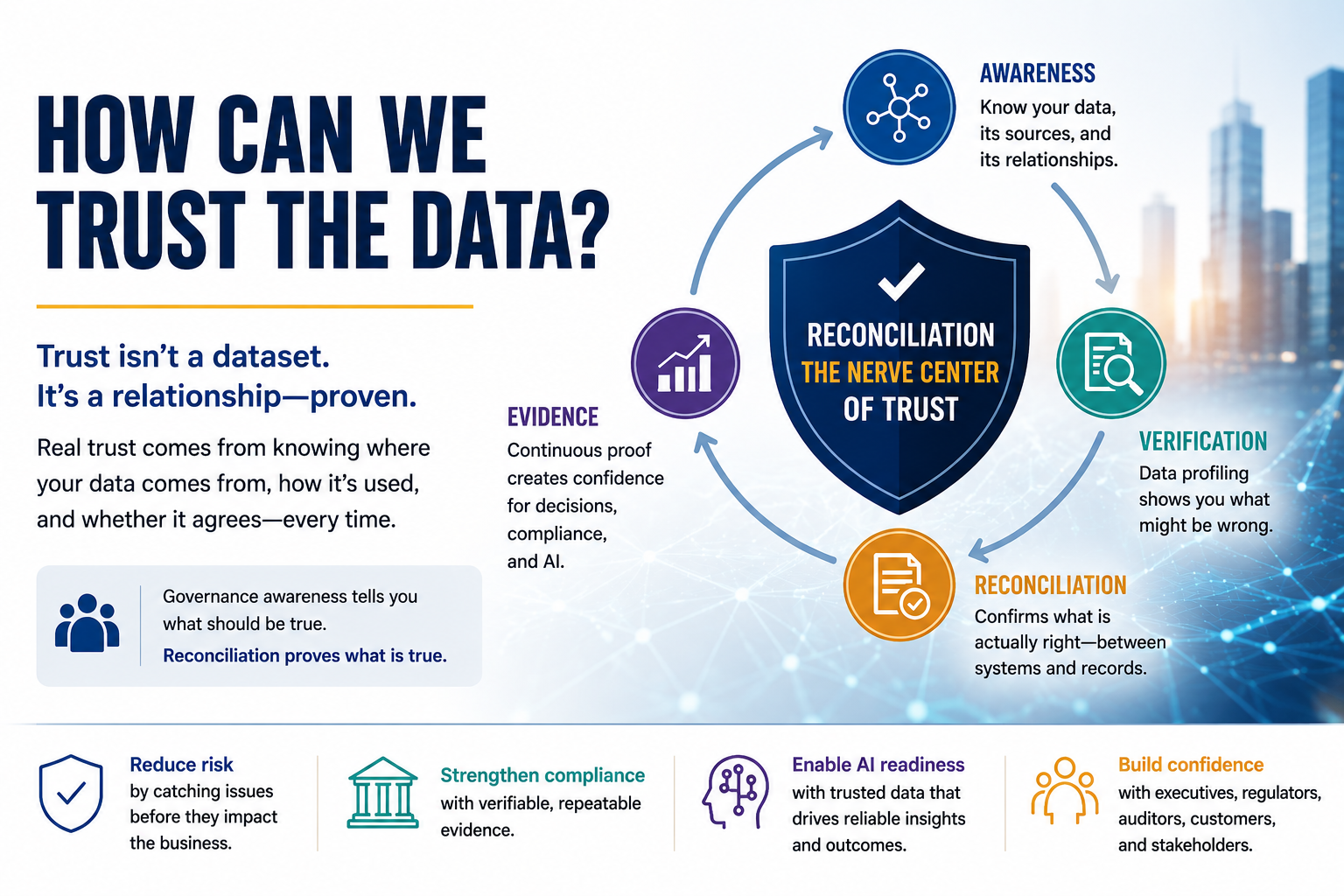
How can we trust the data?
How can we truly trust data as it moves across an increasingly complex enterprise? This article, Steve’s contribution to TDAN, explores a fundamental shift from governance awareness to governance by proof. An Enterprise Reconciliation Control Framework continuously verifies the critical relationships connecting systems, transactions, reporting, risk models, and AI. Because trust is not created by documentation alone. Trust requires evidence—and evidence requires continuous verification.
-
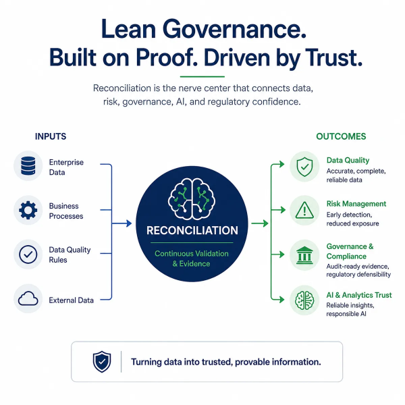
Developing the Nerve Center of Trust
Most organizations still govern data through policies, committees, and documentation — but regulators, executives, and AI systems are now asking a far more difficult question: Can you actually prove the data is correct? In Steve’s this column article on TDAN, he explains why governance must evolve from passive oversight into a continuous, evidence-producing control system where reconciliation becomes the operational nerve center connecting data quality, risk management, governance, AI reliability, and regulatory defensibility. In the age of AI, governance without proof is no longer governance.
-

Elevating Reconciliation to Primary Control for Data Risk
We’re governing data wrong. Policies and profiling don’t catch the real risk: data misaligning across systems as it flows to critical reports. True control means shifting from governing documents to governing flows. Steve’s blog on TDAN argues we must elevate data reconciliation from a back-office task to the primary, preventive control for data risk. This lean approach embeds assurance into the process, validates truth between systems, and provides real-time evidence for oversight.
-
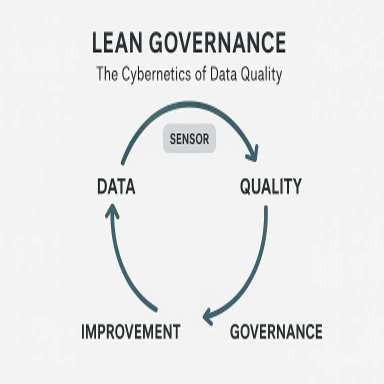
The Cybernetics of Data Quality
What if Data Governance could sense problems, respond to them, and continuously improve itself? This article, contributed by Steve to TDAN, explores the Cybernetics of Data Quality—treating governance as a living system of sensing, feedback, reconciliation, and adaptation. By connecting data quality, lineage, metadata, business glossaries, and stakeholder awareness, organizations can move beyond static governance toward continuous, self-correcting controls—the foundation for trusted data and reliable AI.
More Resources
Projects are enhanced by data awareness and data reconciliation from inception through ongoing support — ensuring every initiative is measurable, validated, and trusted.