
Need for an Integrated Governance Framework
At a recent Data Governance conference, we had the opportunity to review several leading governance technology solutions. In their own right, these solutions were impressive, offering a wide range of business and technology capabilities. As practitioners of Lean Governance, we are always on the lookout for solutions that drive total data awareness across the enterprise. Awareness that enables companies to optimize and leverage their data assets in a controlled manner.
Individual components such as lineage or a business glossary were delivered as elegant, visually appealing solutions. But as a practitioner focused on enterprise data awareness and risk management, I viewed these solutions as part of the problem, not the holy grail promised. In practical terms, what good is a lineage map if the data quality does not meet minimum standards? What is the true value of a business glossary if the owners, consumers, and locations of the data are unknown? How can companies mitigate risk if they are unaware that the true system of record is a spreadsheet that is not integrated into a production control environment? This last point is where Master Data Management and Data Governance need to come together and break down their organizational silos.
We see parallel scenarios when clients ask us to help leverage their governance tool investment. Their version of an Awareness Matrix is often a PowerPoint slide. Their stewardship model is maintained in a spreadsheet. Controls and lineage are outlined in Visio diagrams. So as technologists, where did things go wrong?
As I continued to walk through the vendor booths at the Data Governance conference, I began to wonder why technologists focused on governance platforms preferred isolated functionality over a more general governance platform that delivered the needed awareness and control. So often, we work with clients who have purchased a governance tool and turn to us in search of value. How can they leverage their investment? Software has been installed and configured, and a targeted project brought in an army of consultants for implementation. The promised value propositions were not realized when the project was done, and they were down to normal staff levels. Implementing multiple tools just increased costs, contract efforts, and training, and brought yet another round of stove-piped metadata. Instead of the promised value, we just see organizational waste and increased technical debt.
While diverse in governance features, these different technologies lacked any sort of integrated governance framework. Instead offering differing degrees of bells and whistles on a subset of governance functionality needed to maintain this critical enterprise data awareness. When evaluating governance solutions, we look for seven key functions that a core platform should have to achieve and maintain Enterprise Data Awareness:
1. Stewardship Model
2. Data Cataloging (logical and physical)
3. Data Quality
4. Data Lineage
5. Structured/Unstructured integration
6. Governance Metadata Model
7. Missing Data Capture (MTM integration)
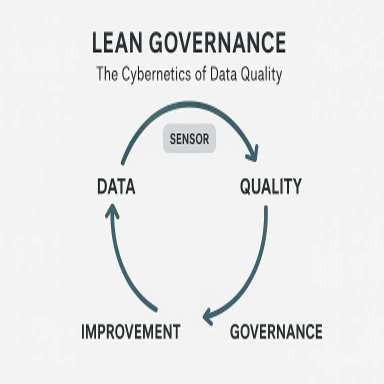
Integration of these functions within a governance platform are required for any real degree of Data Risk Management and overall governance control. The worlds of Data Governance and Information Governance can be brought into this integrated umbrella for total awareness. As we have written in previous columns, governance metadata is the glue that binds these functions together and enables ongoing maintenance across the ever-changing corporate and data landscapes.
The manufacturing world learned decades ago that integrated technology that had sufficient features to increase the factory productivity through inventory management were more suited to Lean Manufacturing than the large specialized systems found in conventional mass production systems. This point was emphasized in Eli Goldratt’s novel The Goal. One of the largest hurdles to going lean was the need to change the perception that specialized inventory management and accounting systems were needed to run a factory. To the contract, these massive, stove-piped systems were large producers of operational waste.
Lean Thinking focused on optimizing inventory level and reducing reliance on specialized systems. Instead the focus was on a technology platform that maintained awareness of the key aspects of running the factory. Factors such as inventory location, inventory quality, production costs, failure rates, were far more important that systems that produced elaborate optimization models designed for the mass production world.
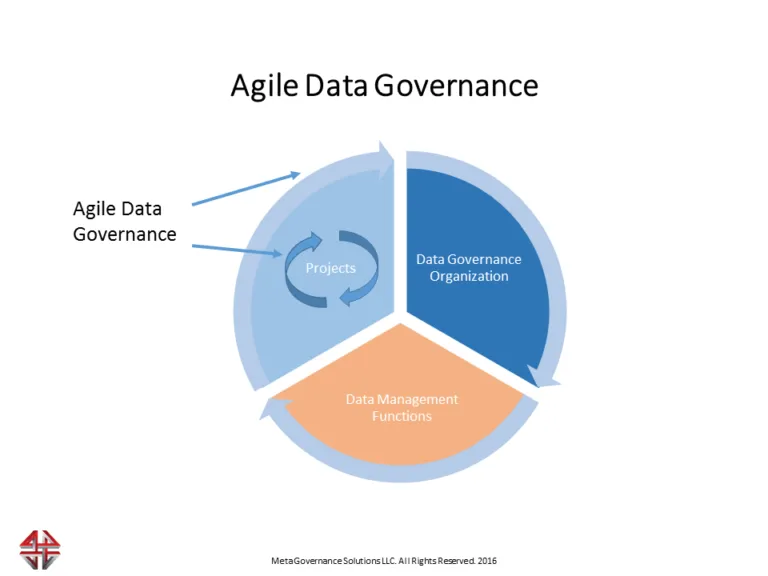
The world of Data Governance and Information Governance is very complex. The functions outlined above have tentacles that cross the organization. But in order to provide value and minimize risk it is critical that we do maintain an enterprise view. Integrated solutions need to begin with content experts that understand governance, technology and most importantly the business model. From there the overall metadata map needs to be drawn that illustrates how all the different aspect of data and control fit together. Once the enterprise meta-map is known, the development of a technology solution is relatively straight forward.
The computer system displacement that occurred in the 1980’s and 1990’s with the transition to Lean Manufacturing were significant. Mainframe ERP systems were replaced with localized technology solutions, resulting in huge cost savings. One of the ironies in manufacturing was that ERP systems had been promoted as one-stop-shopping for all the technology needed to run a factory. In principle these were integrated technology frameworks. In reality they were very cumbersome and unforgiving if the factory business model was not a perfect match with the vendor solution.
Russel Ackoff is noted for his quest to always solve the right problem. In his management books he often talks of elaborate systems, both technology and organizational, that are targeting the wrong problem. Right solution to the wrong problem. We see the typical Data Governance technology in a similar light.
As governance specialists, we view what is needed is a system reboot. Literally. Step back and understand what organizational problems you are trying to solve. Where is your data risk? Where are your data inventory blind spots that keep business and risk managers up at night? What is the overall flow of data through your organization? Begin to realize that Data Governance and Information Governance are actually complex puzzles that are interwoven and fun to solve. These are the steps needed to define a lean data factory that is designed to maximize business value for stakeholders, both internal and external. To provide the right mix of risk and control in alignment with organizational drivers. When you understand this data inventory landscape, you can then begin to evaluate different governance vendor solutions. You will find that integration is far more important than bling.