
Lean Governance: The Next Machine to Change the World
In 1990, the landmark book The Machine That Changed the World transformed how executives thought about manufacturing. Based on a five-million-dollar Massachusetts Institute of Technology study, it explained why Japanese automakers were dramatically outperforming their Western competitors and introduced the world to lean production. The lesson was simple but revolutionary: organizations that eliminate waste, improve quality, and build continuous process control outperform those that rely on volume, complexity, and correction after failure.
The manufacturing world changed because leaders realized that quality could not be inspected into a product after the fact. It had to be built into the process itself.
Today, we face the same challenge in data governance.
Modern enterprises are not simply producers of goods and services—they are data factories. Every operational decision, regulatory report, financial disclosure, strategic forecast, and AI model depends on the continuous production of trusted information. Yet many organizations still manage data using outdated factory methods: fragmented processes, spreadsheet dependence, manual reconciliations, unclear ownership, and reactive corrections after problems emerge.
The result is predictable—waste, inefficiency, and risk.
Just as lean production changed manufacturing, Lean Governance must become the next machine to change the world of Data Governance and Enterprise Data Management.
The Japanese engineers who pioneered lean production identified a problem they called muda—waste embedded in the production process. They observed unnecessary motion, duplicated effort, inconsistent quality, and broken feedback loops. Their solution was not simply better inspection; it was to redesign the system so defects were prevented rather than discovered later.
Most corporate data environments suffer from the same condition.
Spreadsheets are still widely used for collection, adjustment, reconciliation, and executive reporting. Data is corrected outside of source systems. Manual intervention replaces process discipline. Reporting teams spend more time validating numbers than analyzing them. Business glossaries are incomplete. System-of-record definitions are unclear. Ownership is assumed but not enforced.
This creates what can only be described as a perfect storm for bad data.
Executives often believe data governance programs solve this problem through policies, standards, councils, and stewardship models. These are necessary, but they are not sufficient. Documentation alone does not create trust. Policies do not prove accuracy. Governance committees do not validate completeness at the moment data is used.
The real question is far more direct:
Can the institution prove, at the moment data is used, that it is accurate, complete, and controlled?
If the answer is uncertain, governance is still operating as administration rather than as control.
This is where Lean Governance changes the conversation.
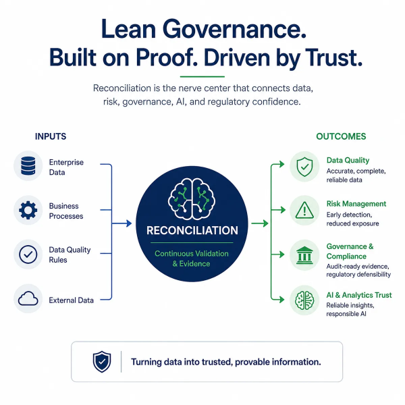
Lean Governance treats reconciliation as the primary control, not as a back-office cleanup exercise. It recognizes that trust is not built through documentation alone, but through continual process control and just-in-time validation across systems. It shifts governance from retrospective review to operational proof.
In this model, reconciliation becomes the nerve center of trust.
Rather than asking whether a policy exists, we ask whether the data can withstand verification between platforms, systems, and reporting layers. Rather than assuming quality because a process is documented, we establish evidence because results are continuously measured.
This is the difference between governance by paperwork and governance by proof.
The first step in Lean Governance is identifying waste inside the enterprise data factory.
This includes the obvious: excessive spreadsheets, redundant reports, repeated manual reconciliations, delayed close cycles, and high defect rates. But it also includes structural waste—unclear lineage, insufficient awareness of authoritative sources, duplicated business logic, disconnected governance ownership, and lack of visibility into how data moves between systems.
Most organizations spend millions modernizing platforms while preserving inefficient control structures. Cloud migration does not eliminate waste if the same reconciliation failures simply move to a more expensive environment. A new reporting platform does not create trust if the underlying control discipline remains unchanged.
Technology without control discipline only accelerates risk.
Lean Governance begins by asking where trust breaks down.
Where are numbers being adjusted manually?
Where do reports require extraordinary effort to defend?
Where do regulators ask the same questions repeatedly?
Where does management rely on spreadsheets because they trust them more than enterprise systems?
These are not isolated operational annoyances. They are symptoms of structural governance failure.
And where there is waste, there is risk.
This is especially true in regulated industries such as banking, insurance, and capital markets, where reporting accuracy is not simply an efficiency issue but a regulatory obligation. Examiners are no longer satisfied with policy statements and governance diagrams. They increasingly expect institutions to demonstrate proof of control—evidence that data is accurate, reconciled, and defensible before decisions are made.
The standard is shifting from governance intent to governance evidence.
This is why reconciliation must be elevated.
Data profiling has value. Metadata management has value. Business glossaries matter. Policies and stewardship are important. But none of these create trust at the point of use in the way reconciliation does. Reconciliation validates truth where it matters most—between systems, before reporting, before decisions, before exposure becomes failure.
It is the control that proves whether governance is real.
Lean Governance does not reject traditional governance disciplines; it operationalizes them. It connects governance to measurable outcomes. It ensures that stewardship is tied to evidence. It transforms governance from oversight into performance.
The goal is simple: zero defects.
Not perfection as an aspiration, but data integrity as an operating principle.
This requires viewing the enterprise as an integrated information production environment rather than a collection of disconnected applications. It requires understanding patterns, dependencies, and behaviors across the full reporting chain. It requires designing governance around how data is actually consumed, not how architecture diagrams suggest it should work.
Most importantly, it requires executive recognition that data quality is not an IT issue.
It is a business control issue.
It belongs to the CEO because trust drives enterprise confidence.
It belongs to the CFO because reporting integrity drives financial credibility.
It belongs to the CRO because unmanaged data risk becomes operational and regulatory risk.
It belongs to the CIO because architecture without control is incomplete.
Lean Governance creates a common language across these functions by focusing on evidence rather than theory.
The promise is substantial. In manufacturing, lean production reduced labor, engineering time, investment tooling, and development cycles by extraordinary margins while improving quality. In data governance, the same principles can reduce operational friction, regulatory exposure, reconciliation effort, spreadsheet dependency, and reporting uncertainty.
But the greatest value is not efficiency.
It is confidence.
Confidence that financial reports are correct.
Confidence that regulatory disclosures can be defended.
Confidence that cloud and on-premise environments remain in sync.
Confidence that AI models are operating on trusted information rather than hidden defects.
Confidence that governance is not a policy binder on a shelf, but a living control system embedded in daily operations.
This is the future of enterprise governance.
Lean Governance is not another framework layered on top of existing complexity. It is a disciplined return to first principles: eliminate waste, establish control, prove quality, and build trust where decisions are made.
The next machine to change the world will not be built on more dashboards, more committees, or more documentation.
It will be built on reconciliation, continual process control, and evidence-based trust.
That machine is Lean Governance.