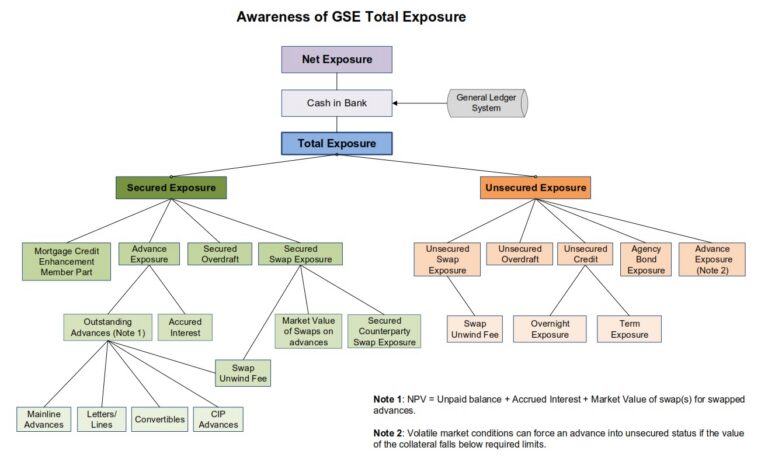
Walk Through Any Data Factory and You’ll Find Waste
Why the focus on waste in your data systems? Because where there is waste there is risk. Risk management priorities drive countless checks and balances to ensure data integrity. Typically, many of these are manual controls involving the use of spreadsheets. These controls end up being a waste of resources. More than that, they don’t solve the problem of weeding out bad data.
Lean Governance is the path to zero defects in your data. The process starts with a search for waste. The use of Value Stream Maps grew out of Lean Thinking as a way to visualize waste in a manufacturing process. The idea was to pinpoint waste, defined as any activity that does not contribute to consumer value. We adapted this lean concept with our Awareness Maps, the product of our walking through a client’s data factory.
To illustrate, we examined the activities involved with an income simulation modeling tool such as QRM or Polypaths. Data is collected from different sources and various simulations are run. The Model Risk team develops the metrics for internal management and external regulators on probable income scenarios for several years in the future. Lean thinking is focused on product quality from the customer’s perspective. The product in this case is the income forecast and quality for the customers is based on the accuracy of data inputs.
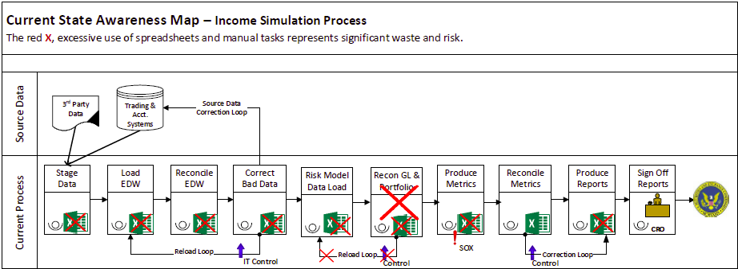
Refer to the first Awareness Map (below) showing the current state. As suspected, we observed significant waste from manual reconciliations, manual data corrections, spreadsheets used for reporting, and rework of bad data. Industry estimates put this type of waste at more than 20 percent of the labor and other resources utilized to minimize operational risk. The irony is that the use of spreadsheets and related manual fixes had the effect of increasing data risk. The second Awareness Map shows the future-state in which waste is eliminated and risk is greatly reduced.
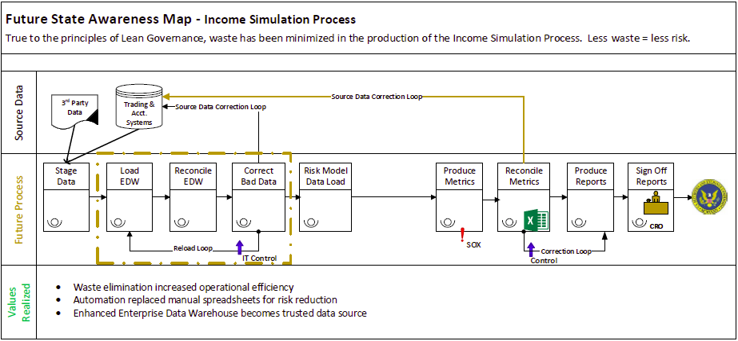
We can optimize a data factory in the same way one improves a manufacturing plant. Major tasks are viewed in the context of the organization to provide a system view of a solution. Manual tasks are automated. In our example, spreadsheets are replaced with database queries. Reconciliations to the General Ledger and portfolios are also automated and shared with all parties. The key is to design a process that ensures data quality inputs while eliminating downstream corrections.
Awareness is the first step to Lean Governance. You can’t fix what you can’t see. Manufacturing was revolutionized by quality experts walking through factories and finding waste. We bring this same approach to improve data quality and the information it produces.
For further study, we suggest the book, “Learning to See: Value Stream Mapping to Add Value and Eliminate MUDA,” by Rother and Shook. It provides an excellent overview on how to maximize customer value through the elimination of waste.