Build a Lean Data Factory and Stop Wasting Resources
Companies spend more time than they should on collecting and validating data. Estimates run around 20 percent. This excessive waste of resources can be even greater for highly-regulated institutions that have to ensure accurate reporting to their auditors and regulators.
Eliminating waste on the manufacturing floor was the key to increased profitability, flexibility, and quality. Those of us focused on data risk management, data governance, and data warehousing can benefit from the lean manufacturing practices that first transformed Toyota, then the rest of the automotive world. The reduction of waste in your own “data factory” will likewise increase product quality, operational efficiency and minimize regulatory risk.
Examples of excessive waste in a data factory include:
1. Using spreadsheets for manual reconciliation
2. Multiple, conflicting sources of truth
3. Inaccurate picture of data sources and ownership
4. Poor communication between data owners and consumers
5. Reliance on spreadsheets for financial disclosure
At MetaGovernance, we help clients build lean data factories. Our goal is to eliminate your sources of waste and improve data integrity. The Japanese have a word for this waste, “muda”, which means futility, uselessness; wastefulness, and is a key concept in the lean process thinking1 . Think of your muda as a data tax.
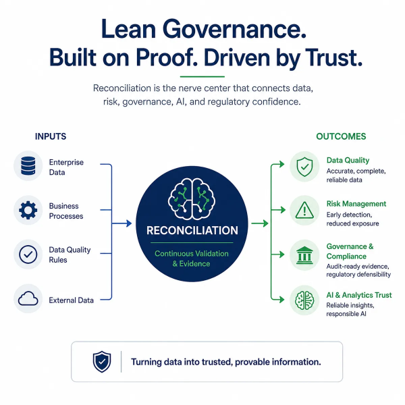
Our search for waste in a data factory begins with how spreadsheets are used in daily operations. Experience tells us that any data between two systems can be automatically reconciliated with very little effort. The key is knowing the critical data leverage points that confirm a system is continually in balance. We call this a state of Governance-in-Motion.
Lean governance is what happens when we combine lean thinking with data governance. It’s all about maximizing the data throughput of a system, defined as data in, data managed and data out. We welcome the opportunity to discuss how you can remove the waste – and risk – in your own data factory. Your teams can then spend more time on value-added tasks that actually produce goods and services. At a minimum you can stop paying the extra 20 percent data tax.
1.