
This is an example page. It’s different from a blog post because it will stay in one place and will show up in your site navigation (in most themes). Most people start with an About page that introduces them to potential site visitors. It might say something like this:
Hi there! I’m a bike messenger by day, aspiring actor by night, and this is my website. I live in Los Angeles, have a great dog named Jack, and I like piña coladas. (And gettin’ caught in the rain.)
…or something like this:
The XYZ Doohickey Company was founded in 1971, and has been providing quality doohickeys to the public ever since. Located in Gotham City, XYZ employs over 2,000 people and does all kinds of awesome things for the Gotham community.
As a new WordPress user, you should go to your dashboard to delete this page and create new pages for your content. Have fun!
- How can we trust the data?
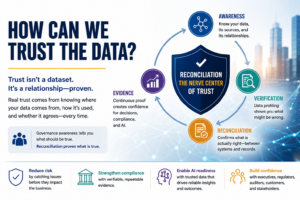 How can we truly trust data as it moves across an increasingly complex enterprise? This article, Steve’s contribution to TDAN, explores a fundamental shift from governance awareness to governance by proof. An Enterprise Reconciliation Control Framework continuously verifies the critical relationships connecting systems, transactions, reporting, risk models, and AI. Because trust is not created by documentation alone. Trust requires evidence—and evidence requires continuous verification.
 - Developing the Nerve Center of Trust
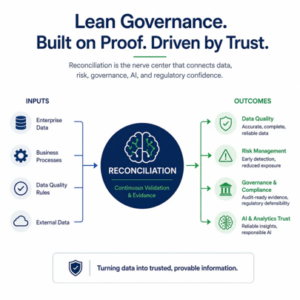 Most organizations still govern data through policies, committees, and documentation — but regulators, executives, and AI systems are now asking a far more difficult question: Can you actually prove the data is correct? In Steve’s this column article on TDAN, he explains why governance must evolve from passive oversight into a continuous, evidence-producing control system where reconciliation becomes the operational nerve center connecting data quality, risk management, governance, AI reliability, and regulatory defensibility. In the age of AI, governance without proof is no longer governance.
 - Elevating Reconciliation to Primary Control for Data Risk
 We’re governing data wrong. Policies and profiling don’t catch the real risk: data misaligning across systems as it flows to critical reports. True control means shifting from governing documents to governing flows. Steve’s blog on TDAN argues we must elevate data reconciliation from a back-office task to the primary, preventive control for data risk. This lean approach embeds assurance into the process, validates truth between systems, and provides real-time evidence for oversight.